
Putting roadmap planning on the map
Summary
Situation
- When I joined Zendesk’s Growth and Monetization team in August 2021, I found the design team lacked a roadmap and worked reactively, which left designers overwhelmed and uncertain about their work.
Actions
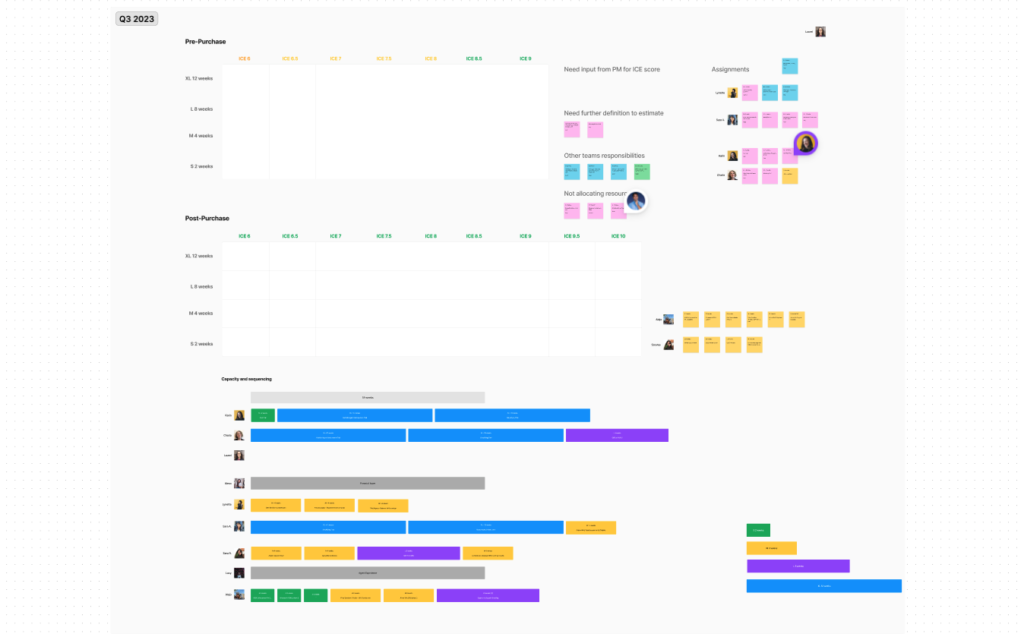
- I took control of the design team’s workload by creating a roadmap planning process based on estimated design effort in weeks, influenced by DesignOps and my past experience.
- Collaborated with Product and Engineering Directors to introduce the ICE scoring system to prioritize projects by Impact, Confidence, and Effort.
- Implemented a quarterly roadmap planning process that involved product discovery, design and engineering estimates, and leadership reviews.
Impact
- By Q4 2022, the process was running smoothly, with improved predictability and focus for designers.
- 20% more projects were shipped in 2022, increasing release speed and experimentation.
- Leadership gained better visibility into the team’s work, and we identified new bottlenecks, such as scaling analytics processes.
Full Story
August-September 2021: Identifying the Problem
- Upon joining Zendesk’s Growth and Monetization (G&M) team in August 2021, I quickly noticed that the design team was working reactively. Product Managers directly assigned work to designers without a formal process, resulting in overwhelmed designers and a lack of clear direction.
- Designers expressed feelings of uncertainty and burnout, and there was no clear vision for managing workload across the team.
- Key Challenge: The previous manager operated reactively, redirecting work only after designers became overloaded, leaving the team without a structured system.
- Solution: I recognized that in a large corporation, we needed a more rigorous approach than what might work in a startup. I realized that I had full authority over design resources and decided to develop a centralized roadmap planning process.
October 2021: Developing the Roadmap Planning Process
- Drawing from my previous experience at Zappos and Zendesk’s DesignOps rubric, I created a framework to measure design capacity in weeks of effort:
- S = 2 weeks or less
- M = 4 weeks or less
- L = 8 weeks or less
- XL = 12 weeks or less
- Based on this rubric, I estimated that a designer could take on 18 weeks of work per quarter, divided into various combinations of project sizes (e.g., 1 XL + 1 M + 1 S). Though the exact capacity could vary, this gave us a solid starting point for planning.
- Key Challenge: There was no existing data on how much work each designer could handle, which could have been a major roadblock.
- Solution: I used my industry experience and instincts to set an initial estimate of 18 weeks per designer per quarter. This estimate would be adjusted as we refined the process.
November-December 2021: Collaborating with Product and Engineering
- I met with the Directors of Product and Engineering to discuss how we could align design efforts with product priorities. They were interested in introducing the ICE score (Impact, Confidence, Effort) to measure project value, but they hadn’t yet formalized it.
- I proposed we broaden the conversation to include Engineering estimates and align design, product, and engineering priorities. We agreed on a process where:
- Product discovery started six weeks before the new quarter (to get the Impact and Confidence scores).
- Design and Engineering estimates would be added four weeks before the new quarter (to calculate Effort).
- Three weeks prior, we would review scores, adjust priorities, and make assignments, then review with leadership.
- Key Challenge: I was the only Manager in a group of Directors and VPs, which could have sidelined my authority.
- Solution: I saw myself as a peer to the Directors, using my authority over design resources to assertively push for changes. This self-confidence allowed me to lead the roadmap planning discussion.
Q1 2022: Pilot Quarter
- We implemented the new roadmap planning process in Q1 2022, but it was far from perfect. We finished the process one week into the quarter instead of two to three weeks ahead of time, and several issues arose:
- Product discovery started too late due to unforeseen project accelerations.
- Leadership reviews were difficult to schedule.
- Design and Engineering estimates were inaccurate as teams were still learning how to estimate effort effectively.
- Key Challenge: The first quarter was chaotic, with delays and misaligned expectations, which could have caused stakeholders to lose faith in the new process.
- Solution: I remained flexible and focused on incremental improvements. We identified areas for refinement, such as starting discovery earlier and training teams on more accurate estimation. I worked closely with all stakeholders to ensure they understood that this was a learning process, and improvements would come in future quarters.
Q2-Q3 2022: Refining the Process
- By Q2, we started refining the process based on lessons from the pilot:
- We initiated Product discovery earlier, factoring in potential delays.
- We ensured leadership reviews were scheduled further in advance, avoiding last-minute conflicts.
- We improved the estimation process by training Design and Engineering teams on more accurate sizing of projects.
- Key Challenge: Adjusting timelines and processes while continuing to meet ongoing product deadlines required careful coordination between all teams.
- Solution: I took ownership of coordinating cross-functional teams, ensuring that product, design, and engineering were aligned on priorities, even when timelines shifted.
Q4 2022: Success and Impact
- By Q4 2022, the process was running smoothly. Designers felt more focused and had better visibility into their workload, which increased efficiency. This predictability enabled faster release times and more experimentation.
- Impact:
- 20% more projects shipped in 2022, compared to the previous year.
- Leadership loved the roadmap reviews, as they now had a predictable way to assess what the team was working on and how it impacted the company.
- The process revealed new bottlenecks, such as the need for more robust analytics and instrumentation to scale with the increased production rate.
Throughout the process, I introduced structure and predictability to a team that had previously been working reactively. My leadership ensured that the design team could handle increasing demands from Product and Engineering, while keeping projects aligned with the company’s objectives. By the end of 2022, we had transformed how the team worked, shipping more projects and delivering higher value to Zendesk.

